

• Skip to main content
  • Skip to header right navigation
  • Skip to site footer
1800 353 053
  • Facebook
  • YouTube
  • Instagram
  • LinkedIn
Heritage Tree Consultancy

Heritage Tree Consultancy

  • About
  • Services
    • Asset & Risk Management
    • Tree Science & Diagnostics
    • Construction & Compliance
    • Planning & Development
    • Soil & Plant Health
    • Explore VOGT
      • Geo Injector Mini
      • Geo Injector Maxi
      • Geo Injector Pro
  • Insights
  • Contact Us
    • Locations
      • Brisbane
      • Gold Coast
      • Redlands
      • Toowoomba
  • Get a quote
Tree Poisoning

Tree Poisoning: How to Avoid the Unintentional Consequences of Mishandled Weed Poisons!

Tree Poisoning is, in most cases, an unintentional outcome to the unsupervised and poorly disciplined spraying of herbicides. This involves the destruction of trees and vegetation by applying toxic substances to the ground directly around a tree’s roots, trunk or foliage. Most herbicides are not designed for woody plants. However, repeated or excessive applications of chemicals of any type are detrimental to soil health as there are harmful to beneficial soil microbes. This results in loss of soil health and therefore plant failure. Some herbicides are deliberately designed to target woody plants and can cause irreversible damage to the trees vascular system which ultimately leads to the death of the tree.

Commonly Used Poisons.

Glyphosate is one of the most commonly used herbicides that can harm trees when applied maliciously or improperly and eventually leads to soil degradation. Glyphosate is biodegradable on the paper, as per the product label. However, biodegradability involves active soil microbiology. This is very rarely the case in urban soils. Therefore, it is more likely that chemical herbicides such as glyphosate will accumulate in urban soils when repeatedly applied. Some research papers also argue that the by-products from the herbicide could also be used as a food source by soil pathogens, which will help them take over the beneficial microbes and put trees at risk of infection. 

Mismanaged or unprofessional and unplanned application of herbicides to combat weeds can often times lead to the accidental poisoning of trees and other plant life in the surrounding areas. When weed spray applications are performed during periods of high air temperature, the herbicides that are otherwise applied to weed foliage end up evaporating and move as a toxic vapor through the air where it’s poison will be spready across everything in the nearby area. This also occurs when there are high wind speeds, as spray particles may end up being carried around if they are light or small enough.

Integrated Weed Management Planning is a very effective tool is both managing and stemming the growth of weeds in a garden while also being conscious and mindful of your beautifully important urban trees. This management program involves the coordinated use of a variety of control methods that reduce the reliance on herbicides and increase the success chances of eradicating any unwanted weeds. Afterall, the best way to manage the spread of weeds is to simply prevent them from growing in the first place. While herbicides will continue to be an integral part of weed management, even in IWM programs, good management practices can do a lot more.

The timely scouting and identification of weeds in a garden, followed by the rapid execution of control methods, is often the most effective solution to reducing the risk of poisoning your trees and plants while eradicating the target weed(s). This also involves the correct and accurate identification of weeds, so that the correct measures and when necessary, the correct herbicides that can be used to target the weeds to reduce the overall reliance on broad range herbicides.
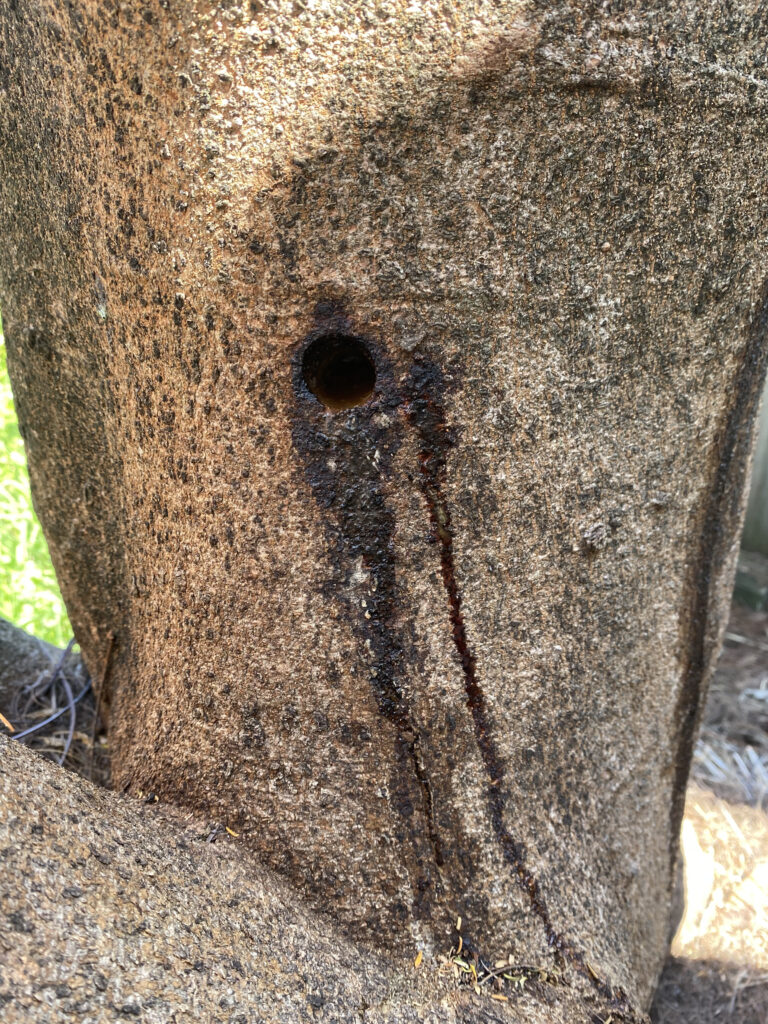
Tree with a drill hole, suspected of chemical poisoning.

Intentional Tree Poisoning: What to do?

In some extreme cases, a tree’s trunk may have been injected with a poison deliberately. This method is used for as a highly effective way to deliver the poison directly into the trees vascular system and spreads throughout the rest of the tree incredibly quickly, often leading to an extremely rapid decline in its health in all areas. By the time symptoms begin to show it can often be too late to act.

If you suspect that a tree has been poisoned, Heritage Consultancy can help you identify the causes of decline and explain what types of tests are available and assess if the tree can be saved and/or the soil remediated.

Tree vandalism and poisoning are serious acts of environmental vandalism that can have lasting consequences on the trees, ecosystems, and communities these crimes are perpetrated in. These malicious acts are often punishable by law, and protecting trees from such harm is essential for maintaining the health of the local environment. Awareness, monitoring, legal protection, and community involvement are critical to preventing tree vandalism and poisoning and ensuring that trees continue to provide their many benefits to society.

If you suspect that a tree on public property has been intentionally poisoned, inform either the Brisbane City Council or your local council as soon as possible. If you believe that a tree on your private property has been either intentionally or unintentionally poisoned, give Heritage Consultancy a call and we can help you identify the causes of decline and explain what kind of tests or remediation efforts can be undertaken to remedy the problem!

Contact us
Heritage Consultancy
  • 1800 353 053
    (07) 3715 5444
Brisbane
  • 25 Spine Street
    Sumner Q 4074
Toowoomba
  • Wilkinson St
    Harlaxton Q 4350
Gold Coast
  • Barnett Place, Molendinar, Q 4214
Redlands
  • Mt Cotton Rd
    Burbank Q 4156
  • Facebook
  • YouTube
  • Instagram
Certification
Registered with OnlineInduction.com
Capability Statement

Copyright © 2026 · Capability Statement · Policies

Get A Quote – Consultancy

Name(Required)
Address(Required)
I am interested in…(Required)
Provide us with additional information regarding your inquiry here. Otherwise you can leave blank.

Supporting Successful Projects Before Construction Begins.

The most effective arboricultural outcomes are achieved during the earliest stages of project planning. By identifying opportunities and constraints before detailed design, Heritage Consultancy assists clients in reducing project risk, minimising redesigns, avoiding construction variations and achieving efficient planning approvals.

Our consultants work closely with developers, architects, planners and engineers to integrate arboriculture into the design process, delivering practical solutions that balance project objectives with environmental and legislative requirements.

Core Services

Arboricultural Impact Assessments (AIA)

Tree Constraints Analysis (TCA)

Development Application Support

Tree Retention & Removal Assessments

Vegetation Management Plans (VMP)

Tree Protection Plan (TPP)

Arboricultural Specifications

Concept & Detailed Design Reviews

Council Liaison & Regulatory Advice

Environmental Due Dilligence

Explore Planning Services Here!

24 Month Plan – Included Services

Treatment of Pre-Existing Stressors.

Treatment of pre-existing environmental stressors present in or around the site.

Plant Tissue Testing.

Performed once every two (2) months. Undertaken to determine what kind of nutrients a plant is absorbing from the ground.

Read more…

Soil Testing.

Performed once every two (2) months. Testing conducted to identify problems or deficiencies with the soil.

Read more…

Soil Microbial Assessments.

Performed once a month. Used to determine the fertility and microbial activity present within the soil, including the presence of diseases and fungi.

Read more…

Comprehensive Agronomist Reports & Consultations.

You may request a full, comprehensive agronomist report at any time, to help you better understand the impact our services make.

Read more…

Nutritional Treatment Plan.

Regular and periodic application of nutritional boosters for soil, lawn and gardens to ensure an even balance of nutrients year-round.

Read more…

Weed, Pest & Disease Prevention.

Performed periodically – we apply weed, pest and disease preventative sprays designed to prevent the encroachment of unwanted and unsightly guests.

Read more…

12 Month Plan – Included Services

Treatment of Pre-Existing Stressors.

Treatment of pre-existing environmental stressors present in or around the site.

Plant Tissue Testing.

Performed once every two (2) months. Undertaken to determine what kind of nutrients a plant is absorbing from the ground.

Read more…

Soil Testing.

Performed once every two (2) months. Testing conducted to identify problems or deficiencies with the soil.

Read more…

Soil Microbial Assessments.

Performed once a month. Used to determine the fertility and microbial activity present within the soil, including the presence of diseases and fungi.

Read more…

Comprehensive Agronomist Reports & Consultations.

You may request a full, comprehensive agronomist report at any time, to help you better understand the impact our services make.

Read more…

Nutritional Treatment Plan.

Regular and periodic application of nutritional boosters for soil, lawn and gardens to ensure an even balance of nutrients year-round.

Read more…

Weed, Pest & Disease Prevention.

Performed periodically – we apply weed, pest and disease preventative sprays designed to prevent the encroachment of unwanted and unsightly guests.

Read more…

6 Month Plan – Included Services

Treatment of Pre-Existing Stressors.

Treatment of pre-existing environmental stressors present in or around the site.

Plant Tissue Testing.

Performed once every two (2) months. Undertaken to determine what kind of nutrients a plant is absorbing from the ground.

Read more…

Soil Testing.

Performed once every two (2) months. Testing conducted to identify problems or deficiencies with the soil.

Read more…

Soil Microbial Assessments.

Performed once a month. Used to determine the fertility and microbial activity present within the soil, including the presence of diseases and fungi.

Read more…

Get a quote

Name(Required)
I am interested in(Required)